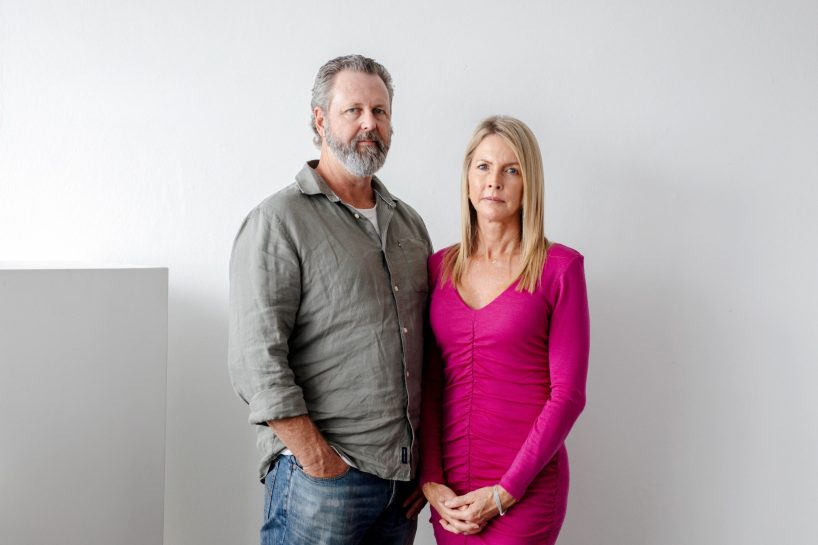
“Normal” meant having a fortunate life
Mark: Prior to losing Sara, “normal” truly meant working and having a fortunate life. My priorities were to be a good provider and make sure that the kids had a good schooling, played sports and did all the things they wanted to.
Julie: Work, kids, family fun; we were really just busy with the kids, sport, school and holidays. Holidays were a really big part of our lives too—we had a lot of fun.
Sara was the bridge
Julie: Sara was the only girl in our family, and she was really close to her brothers either side of her—she was the bridge for them with each other too. She was particularly maternal with her younger brother. I’ll never forget the day she realised he was finally taller than her. She would stand on the steps so she could still hug him.
Mark: My fondest memories of her were from when she worked with me. I used to work in the drilling industry. I was the driller and Sara was my crane operator, which is a pretty specialised role. All the blokes on site would be around trying to help, puffing their chest out, and I would just hand her the remote and she would handle the crane, and put everyone to shame.
But as smart as she was beyond her years, she was still just a young girl with the same anxieties as young people her age. Another time we were on a mine site, and it took forever, and Sara really wanted to know when we were leaving to go back home. I didn’t have an answer for her, but she kept asking, and asking. Finally, she admitted she was anxious to get home because “Thursday night was tanning night!” [laughs].
The incident
Mark: At the time of the London Bridge attack, I was working in Canberra. I was working 7-days a week, 14 hours-a-day so we could go and meet Sara. We were 27 days away from meeting her in Paris.
That weekend, Jules had flown down on the Saturday afternoon to have dinner and fly back Sunday. We woke up Sunday morning to go to the airport and we received a phone call: “Did you know there’s been another attack?” At first, we didn’t worry too much but we kept an eye on it just to be on the safe side.
When Jules returned to Brisbane, some officers came to the house and asked to speak to her—they didn’t allude to anything about Sara’s status and it was all quite unclear. No information was given. Once I found that out, I started ringing all the hotlines in London. Seven hospitals received victims from the attack. Not long after that, we received a phone call from the family that Sara was nannying for to say they had given her the night off and she hadn’t come home.
They had her listed as a missing person. But again, we didn’t imagine the worst. We thought—hoped, that she was okay. Eventually the media started coming to our doorstep and waiting on the median strip out the front of our house. But we still knew nothing.
The devastation
Mark: I flew home to Brisbane on Monday night, which was when reality hit that something serious had happened.
Julie: We had all our friends over, and we were just ringing Sara, non-stop. But then on Tuesday, AFP said, “We have a body, and we suggest you travel.”
Mark: One of the hardest things I’ve ever had to do was tell our youngest son, “We need to go to London, there’s a possibility that your sister might be dead.” It was all done so badly. For three days, we were in that limbo of not knowing. Even when you’re told that news when you’re flying from Abu Dhabi to London, until you see it, you hold out hope that they’ve got it wrong.
Julie: I was so sad I couldn’t be there to console my son. He’s the one that broke the news to us. We were on the plane between Abu Dhabi and London, and we got his message the moment we came into a bit of reception. I felt like the worst parent. It was just horrendous. I just screamed, and I couldn’t breathe.
Mark: The world learned about Sara’s death before we did.
Mark: 2017 was a black hole. I actually went back to work because I couldn’t cope. I couldn’t deal with it. It was just deep heartache and broken heartedness. I couldn’t go into her room. I couldn’t deal with the fact I wouldn’t see Sara for the rest of my life.
Mark: It was a time of deep sadness, depression, and asking, “Why Sara?” I just kept thinking, “How do I support our two boys? How do I support Julie?”
A switch, flicked
Mark: One silver lining was that we were well supported by Metro Police. They made sure to give us lots of time and space, and lots of warning about what the days could look like. It was the first time we had the thought that we need to create a system like this to help guide other people through trauma and grief.
Unknowingly, Jules and I were supported in that thought. Even though we were in this incredible grief, there was almost an immediate switch—money is not important anymore. How do we support families? How do we support our boys? Work kind of meant nothing anymore. By focusing on work, I felt like I would be forgetting Sara. There was no honour to Sara or meaning to her personally.
Julie: We had a lot of people after the event come up to us that we didn’t know who Sara had helped. People who had been suicidal or bullied – and that was so nice to hear. We knew she had all of those nurturing qualities, but no idea just how many people she had touched.
Mark: We founded Sarz Sanctuary to have people try a “tasting plate” of sorts for different modalities of healing. Your needs change along with your journey, and what works at one time in your life, might not work in others. As a survivor, you go through the wringer—there is so much you have to go through as a survivor.
Julie: No one guides you. No one tells you if you’re entitled to anything.
Mark: COVID changed how we do things and we had to create a different way for people to connect. The digital sanctuary was one way of doing it during COVID. It was a bit of a blessing as it gave us so much reach in what we do.
Continuing with love and fear
Julie: We are all on our own journey. Mark and I have had a sea change. I’m in the process of writing a book. Our sons have moved in together.
After you lose one child, you do become more paranoid about your other children. Sara went to a relatively safe country and never came back. There are no guarantees, and it is so hard to accept that.
Mark: We do really feel that Sara guides us through what we do. She is a strong earth angel.
Julie: Helping to heal someone else, helps me. Helping other people out is a big part of my healing—our healing.