The early years in Australia
I remember having a really good childhood in Hong Kong. I was in an international school which was very, very diverse with lots of people from different parts of the world there. Both my parents were professionals. We had domestic help at home. I remember really enjoying school and lots of extracurricular activities quite a lot.
We came to Australia in about 1995 in response to the uncertainty of Hong Kong’s handover in 1997. I remember being quite excited about moving to Australia but it was actually more challenging than I originally thought. I think it was the first time we realised we “were different.” I remember someone telling me that “there’s this politician who’s on TV, doesn’t like Asians. Does that mean you are going to get kicked out?”
While my primary schooling was reasonably unproblematic for the most part, I had a hard time fitting in for the first couple of years of university.
I was searching for an identity.
I remember getting that reverse culture shock because it was a lot more diverse and also a lot more people from my background (Chinese/Hong Kongers) and I actually had a second sort of crisis in terms of fitting in.
Reverse culture shock
Going on exchange was a huge highlight for me because it was the time when I could be more independent. But again when I came back from exchange, I had a reverse culture shock coming back to Australia. These experiences have really stuck with me.
These parts of my life are where I learned to deal with my ups and downs. They probably account for why I am so drawn to humanities-oriented work, even if I didn’t get there straight away… because of the potential of being a cultural scapegoat for certain things like racism.
Not long into my stint in the banking sector, I was feeling the urge to explore something different. My turning point came when I spoke to a friend who was a teacher in outback South Australia. She told me all about her experiences teaching in remote Aboriginal communities and I thought “Oh my goodness, I want to try this!”.
A few months later, I applied for Teach for Australia. Six months after that I started my teaching post in Canberra, teaching humanities in high school. It was a new lease on life and I actually have never worked so hard. It was hard. It was frustrating, but at the same time it was sometimes also just really joyful. It was fulfilling.
The day of the attack

Then 2015 hit. I remember that time really vividly.
It was the September-October school holidays and I was at the Flinders Ranges with friends in South Australia. It was one of the most spectacular experiences – it was like at that point when you’re crying, thinking “can life be any better?“.
Then on the night of the second of October, we were walking into a restaurant and a friend got an alert on this phone. He says to me: “Oh, there’s been a shooting? A suspected terrorist attack outside the New South Wales Police Headquarters! That’s where your dad works right?” I was like, “well, I better give him a call just to see if everything’s okay, but I’ll do it a bit later”. I wasn’t overly worried at that moment.
As we sat down and ate, I remember calling his phone and it went straight to voicemail. I did think to myself: “oh that’s a bit odd, but no biggie”. I then called home and Mum hadn’t heard from him either, and she was starting to worry: “he doesn’t normally come home so late”.
Less than 30 minutes later, I get a call from my sister. I could tell that she was in tears over the phone: “did you hear what happened outside the police?… The police have just called me to inform me that … the person that has been killed… was Dad.” There was a sinking feeling when I heard that.
My sister was an instructor on a study camp, so she was also away. By this time it was about 8:30-9:00pm South Australia time and because we were in McLaren Vale, we wouldn’t be able to make it in time for the last flight back from Adelaide to Sydney. Mum was absolutely distraught.
I remember calling Jetstar to change my flights. I remember that my hands were shaking. I told all of my friends what happened and obviously no one was in the mood for eating after that. We just left and went back to where we were staying. It was just a really, really strange night. When we went back I suggested we do something to take our minds off of it. So we ended up playing Cards Against Humanity of all things!
Already tempting fate, it was my turn to select the Black card. I flipped and it read:
“How do you console a grieving friend?”
Everyone starts looking at their cards nervously. My friends looked at me – “What are we doing? We don’t have to play this card, Alpha!?”. My friends hate me telling this story. But this moment of pure dark humour makes me light up, even if just temporarily.
Whose grief is it?
The afternoon I got back was just so, so awful. Mum was just in a really bad state. We had police over. And the requests were already coming in: “Alpha, we need to release a press statement.”
Bless my friends, they would just drop everything for us. We went through this press statement with a fine tooth comb. Within 20 minutes of us clicking “send”, the headlines were already there. It was the first time I kind of got a sense of how what I choose to say will be reacted to. It was just all so overwhelming.
Planning dad’s funeral was such a huge project. It was kind of crazy. I was really rising to the occasion and I remember one of the family support counsellors took me aside and said“Alpha, I’m really worried about you… you’re operating at such a high level…”.
I realised that my psych background and all my other ways of coping had kicked in. All those formative experiences in my past helped me understand some of my physiological reactions and I was sort of taking mitigating steps. I was really aware of that. And then when I was able to vocalise that, they were OK. But even so, I don’t think I even managed to get any sort of grieving in that time.
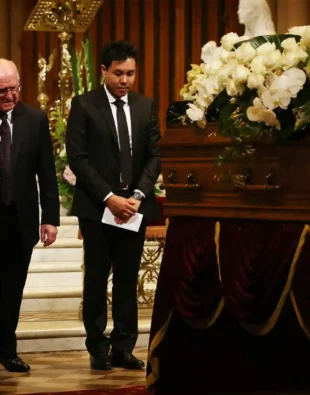
The funeral was about three weeks afterwards. It’s all scattered. I can’t even remember how things happened in sequential order anymore. A massive blur. One thing I do remember is that the Police Catholic Chaplain took me aside and said: “Alpha, you didn’t have to do this, but thank you for putting aside your personal grief to address a collective grief”.
Me and a couple of friends spent all of the days prior going “what do we want to say?” and “what kind of message do we want to give?” We could have been angry. We could have been distraught and sad. There were definitely elements of finger-pointing, of blaming religion, ideology, and immigration that were happening. Things like that. But instead, we chose to be uplifting.
To celebrate the life that Dad had and not give into the reaction that they wanted.
Back to school
I actually went back to work five weeks later.
And I had to address the elephant in the room about why I was away. It’s not like no one knew. I remember the first class I went back to – it was a year 10 maths class.
I took the opportunity to address it and any questions that [the students] may have had. One student put up his hand in the back of the room and said,
“Oh, I have a question. Mr Cheng, what do you need from us to help you through this difficult time?” And that was really, really beautiful.
After a while, I was starting to be extremely exhausted again. The trials were starting – that was absolutely harrowing. I was up and down between Sydney and Canberra a lot. Eventually, I just realised “I don’t think this is for me anymore.” I was a lot more anxious. I was a lot quicker to be frustrated.
A new direction
I think this was set in motion when I went to Israel as part of a teacher’s program, where we met a dozen Holocaust survivors. I remember the ability for these individuals to transform their trauma into messages of hope; of not letting that event define you in a negative way; of using them to promote compassion.
There was also a sense of “never again”, that we will do anything we can to not let something like what we’ve experienced happen again.
With my lived experience and skill set, maybe I want to try policy?
In a strange way, I can rest in the comfort that Dad had got to the stage where he lived a really fruitful life. He was at a stage in his life where he was at peace with himself. Being proud of my sister and I being grown up. He was also getting spiritual as well, getting a lot more involved with his Buddhist practice. Those were a lot of things that helped me not be angry.
I think believing that is the ultimate form of defiance to the intent of the terrorist act itself.